top of page

A Gift Between Friends: One Living Liver Donor’s Story

  • Barbara Doyle
  • May 20
  • 5 min read

A Friendship That Changed Two Lives


Two female friends with heads together, smiling

When Christina Haines met Nicole in a college English class more than a decade ago, neither of them could have imagined where their friendship would lead.


What started as casual conversations before class quickly grew into a deep and lasting bond. They shared adventures, milestones, and eventually the joys of family life as Nicole became a mother to twins. Through it all, Christina knew her friend was living with a liver disease, though Nicole rarely spoke in detail about it.


“She never wanted her illness to define her,” Christina recalled.


For years, Nicole managed her condition quietly while continuing to build a life centered around family, friendship, and resilience. But by 2019, everything changed.

Five people gathered around a picnic table, smiling for the photo. A young boy and girl are eating ice cream.

Learning the Reality of Liver Disease

Nicole had been diagnosed as a teenager with Primary Sclerosing Cholangitis (PSC), a rare chronic disease that damages the bile ducts and liver over time. As her condition worsened, treatments became less effective, and hospital stays became more frequent.

Eventually, doctors delivered the difficult reality: Nicole needed a liver transplant.

Like many people, Christina assumed organ transplants relied entirely on deceased donors. She knew about kidney donation, but had never heard of living liver donation.

Then one conversation changed everything.


“You know,” Nicole said casually one day, “you could potentially be my donor.”


Christina was stunned.


“How is that even possible?” she remembered thinking.


That night, she began researching living liver donation and discovered something remarkable: the liver is the only organ capable of regenerating itself. A healthy person can donate a portion of their liver, and both the donor’s liver and the recipient’s liver can grow back over time.


But she also learned about the risks, the surgery, and the long recovery process.


“It was overwhelming,” Christina said. “There was never any fear or uncertainty on my part. There were questions and hesitations about what was involved, but there was always this peace surrounding it and an idea of 'this is what I have to do' because I wanted to do it. I also knew this was someone I loved deeply.”


By morning, her decision was made.


“Let’s do this.”


The Journey to Becoming a Living Liver Donor

Christina volunteered to be evaluated as a potential donor shortly after Nicole was placed on the transplant waiting list.


What followed were months of extensive testing and evaluations.


The process included:

  • Blood testing and compatibility screening

  • MRI and CT imaging

  • Cardiac evaluations

  • Psychological assessments

  • Meetings with surgeons, social workers, nutritionists, and transplant specialists

  • Discussions about risks, recovery, finances, and long-term health


Throughout the process, Christina had her own independent medical team focused entirely on protecting her health and well-being.


“Every person I met made it clear that my safety came first,” she said. “At every stage, they reminded me I could change my mind.”


The transplant team also emphasized the emotional side of donation. They wanted to ensure Christina fully understood the magnitude of the decision and had a strong support system in place for recovery. She did.


Her family stood beside her throughout the process, even when whatever was to come next felt overwhelming.


Preparing for Surgery

As the transplant date approached, Christina focused on preparing both physically and mentally.


She adjusted her diet, exercised daily, worked closely with nutritionists, and made lifestyle changes to ensure she was healthy enough for surgery. At one point, she and her father walked miles together each morning to help her meet the hospital’s health requirements.


Meanwhile, Nicole’s condition continued to decline.


“There was an urgency to everything,” Christina said. “We knew time mattered.”


Finally, after months of preparation, the surgery was scheduled for October 15, 2019.

When Nicole called to confirm the date, the two friends cried together over the phone.


“We talked about everything,” Christina said. “What scared us. What excited us. And how connected we already felt going into this.”


“See You on the Other Side”
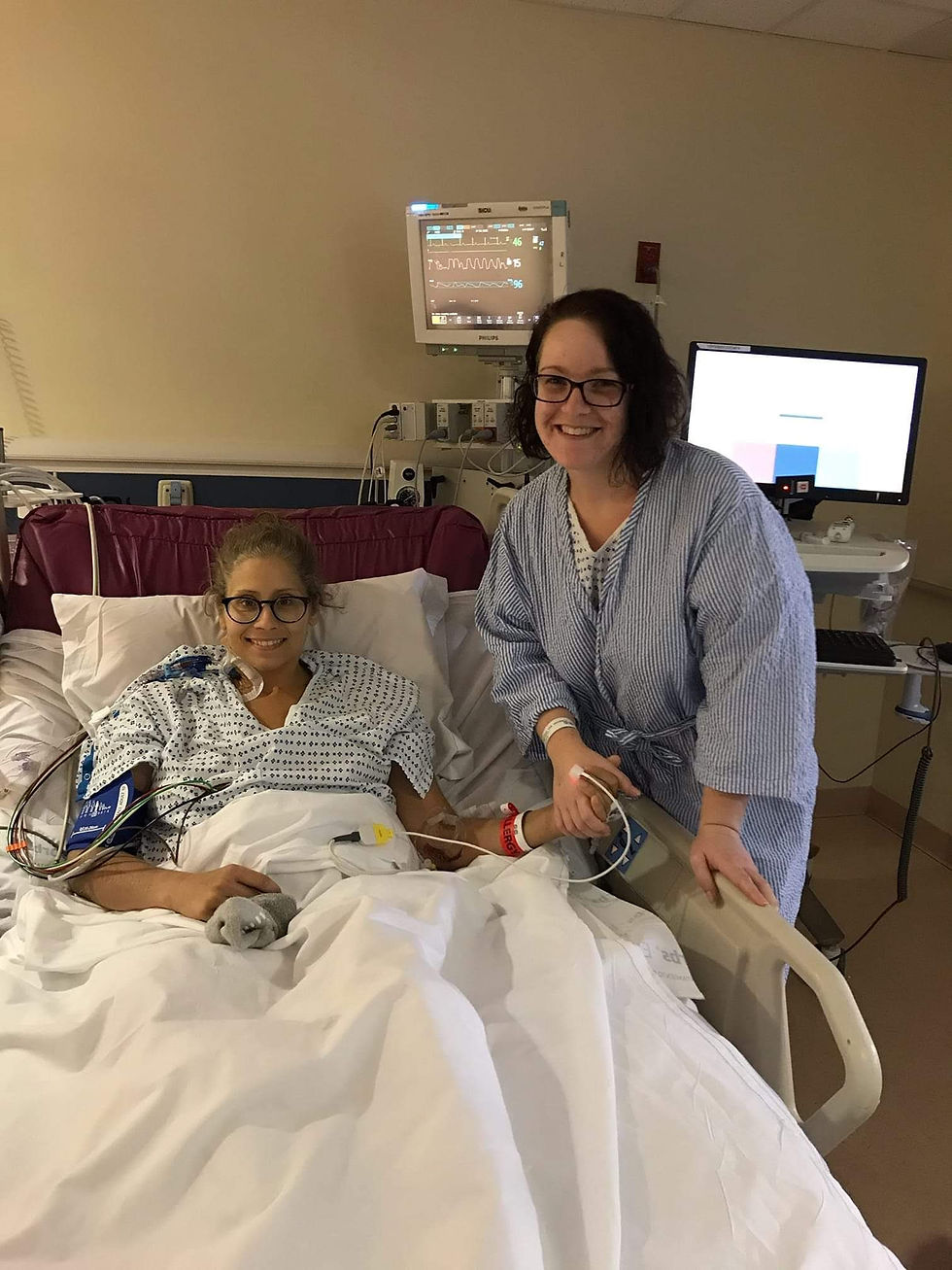

Two female friends in hspital gowns holding hands in a hospital room

On the morning of surgery, Christina and Nicole met in the hospital hallway at Yale New Haven Transplantation Center before being taken to separate operating rooms. They hugged.


“See you on the other side,” they told each other.


The surgery lasted nearly seven hours. While Nicole underwent the transplant procedure, Christina donated a portion of her liver in an adjacent operating room. When she woke in the ICU afterward, her first thought was not about herself.


“Is Nicole okay?” she kept asking.


The answer was yes. The transplant had worked.


Recovery, Healing, and Hope


Christina is posing in a bathing suit, showing her liver surgery scar.
Christina is proud of her scar.

Recovery was not easy for either woman. Christina spent days in the hospital recovering from major surgery and weeks regaining strength at home. Nicole faced additional complications and remained hospitalized for a little over a month while doctors monitored her body’s response to the transplant. But despite the challenges, both women recovered.


Within weeks, Christina’s liver regenerated as expected. Today, she lives without lasting health complications from the surgery.


“I honestly just see the scar as part of my story,” she said.


For Nicole, the transplant meant something even bigger: a second chance at life.

A chance to continue raising her children. A chance to build new memories. A chance for more time.


Raising Awareness Through Donate Life CT

Today, Christina and Nicole use their experience to educate others about living organ donation and transplantation. Both women are actively involved with Donate Life CT and the Yale New Haven Health Transplantation Center, where they share their story with prospective donors and recipients. Many people still do not realize that living organ donation is possible, especially living liver donation. Their goal is to change that.


“One organ donor can save and heal more than 75 lives,” Christina said. “People don’t always realize how powerful that decision can be.”


Understanding Living Liver Donation

Living liver donation is a life-saving option for people with severe liver disease. Because the liver can regenerate, a healthy person may be able to donate part of their liver to someone in need.


Benefits of living donation can include:

  • Shorter wait times for transplant recipients

  • Better transplant outcomes

  • Surgery scheduled before a patient becomes critically ill

  • Increased survival rates


Not everyone is eligible to become a living liver donor, and the evaluation process is intentionally thorough to protect donor health and safety.


The Lasting Gift of Friendship


Christina and Nicole posing for a photo at a gala

For Christina and Nicole, transplantation became more than a medical procedure. It became a lifelong connection rooted in trust, sacrifice, and love.


“We became connected in a way that can’t be undone,” Christina said.


Their story is a reminder that organ donation is not just about medicine. It is about people. Families. Friendships. Second chances. And sometimes, it is about one person saying yes when another person needs them most.


Learn More About Organ Donation

To learn more about living donation or to register as an organ donor, visit Donate Life CT and help give the gift of life.

Comments


ORGAN RECIPIENT STORIES  ·  DONATE LIFE CONNECTICUT

Twice Saved:

Melissa Reynolds’ Extraordinary Journey Through Two Organ Transplants

Every organ donor makes a choice that echoes long after they’re gone. For Melissa Reynolds, two such choices — made by two strangers — kept her here to do the work she was born to do.


On the evening of October 9, 2024, Melissa Reynolds walked into Hartford Hospital not knowing she would not walk out again for four months.

She hadn’t planned to be admitted. She had gone from her endocrinologist’s office directly to the emergency department at her doctor’s insistence, bags unpacked, husband by her side, her mother meeting them there. Melissa, a recreational therapist at the Institute of Living since 2007 — one of Connecticut’s premier psychiatric care facilities — had spent years caring for some of the state’s most vulnerable people. She knew how hospitals worked. She didn’t think she was that sick.

She was wrong.

What followed was one of the most remarkable — and harrowing — journeys of survival that Donate Life Connecticut has ever had the privilege of hearing. It is a story about the fragility of life and the stunning resilience of the human spirit. It is a story about the extraordinary generosity of organ donors and the ripple effect of their gift. And it is a story about a woman who, even at her sickest, was already thinking about how she would give back.

A Health History She Couldn’t Outrun

Melissa had always known her immune system was compromised. She had fatty liver disease and a cluster of autoimmune conditions that made her body work harder than most just to get through the day. Working in a residential psychiatric program since the height of the pandemic in 2020, she had been exposed to illness repeatedly — and had come through it each time. 

In June of 2024, she caught COVID again. It wasn’t the first time, and initially, it didn’t seem like the last. But this time, she didn’t fully bounce back. She pushed through — traveling internationally, working, living — even as her body was quietly losing a battle she didn’t know she was fighting.

“I was tired. I knew I was sick, but since COVID in 2020, I was always kind of sick. It was hard to know when things had really changed.”


By the time her endocrinologist examined her in early October, he couldn’t send her home. He triaged her directly to Hartford Hospital.

Into the ICU

The emergency department at Hartford Hospital was crowded the night Melissa arrived. She waited hours. When she was finally admitted, she had no idea how long she would be there. Her MELD score — a measurement of liver disease severity used to prioritize transplant candidates — was critically high.

Over the weeks that followed, Melissa was transferred between floors multiple times. Codes were called. She was moved to a cardiac unit. She experienced what clinicians call ICU delirium — a state of profound disorientation brought on by critical illness, sedation, and the relentless sensory disruption of intensive care. For Melissa, it was severe. The boundary between what was real and what wasn’t collapsed entirely.

“I thought I was dead. I saw a lot of themes around death. And there was always some truth to what I was seeing — I was dying. I just didn’t know it at the time.”

She would look over from her bed, confused, not knowing where she was or what day it was, and find a nurse standing there, smiling. “I got you. I got you.” It was a face she came to anchor herself to — a steady, human presence in the chaos. When the delirium finally lifted, she looked at that same nurse and thought: “Oh my God. You’re real.”

“I think what they say is true,” she reflects. “You don’t always remember what people did, but you always remember how they made you feel.”


Melissa spent at least six weeks — by some accounts, eight — in the ICU. Her coworkers at the Institute of Living didn’t know if she was coming back. Her family gathered. They had the kinds of conversations families have when hope is uncertain, and decisions are urgent. The news was that heavy.

The Call That Changed Everything

Two days after Thanksgiving 2024, a doctor came to Melissa’s bedside and told her they had found a liver.

She doesn’t remember every word of that conversation. She was still fragile, still in and out of clarity. But she remembers the essential facts: the donor was a woman in her late 30s who had died, the doctor believed, in a car accident. Young. Someone with a whole life ahead of her.

“I wish I could have remembered more from when he told me. But I was just so focused on what was happening next.”

What happened next was a full liver transplant performed overnight by Dr. Serrano and Dr. Emanuel. Because it was a holiday weekend, both surgeons worked through the night together. By Sunday morning, Melissa’s husband received a call. The surgery had gone well.

She came off the ventilator on Tuesday. Physical therapy began on Friday.

November 30, 2024. That date is now etched into Melissa Reynolds’ life the way birthdays are — because in every meaningful sense, it was one.


A Long Way Home

Recovery in the ICU and rehabilitation unit was not linear. Melissa went back and forth between care floors, navigated setback after setback, and slowly, painstakingly, began to rebuild what her body had lost. She relearned how to stand. She worked with physical therapists, occupational therapists, and speech therapists. She continued dialysis three times a week, because the liver transplant had left her kidneys under severe strain.

She remembers a moment with her physical therapy team that she still talks about. She was frustrated. Her body wasn’t doing what she told it to. She couldn’t understand why something so simple felt impossible.

“They got down to my level and said, ‘You just had a liver transplant. You are so strong.’ And that was almost what I needed to keep going.”


A doctor on the rehabilitation unit told her she was one of the most motivated patients they had ever had. Melissa’s response has stayed with everyone who heard it:

“I have to be — and I have to stay positive — because I can’t even figure out how to get up or stand up. I have to get out of this hospital. I have a life left to live. I have to get back to work someday.”

That drive — paired with the daily encouragement of the nurses, therapists, dietary aides, and every staff member who walked through her door — is what she credits with pulling her through. “I am so thankful for the staff who kept me going every day and helped me to stay positive and focused,” she says. “Without them, I don’t think I could have done it.”

There were hard moments, too. One of them came when a doctor quietly told her that she would not be going home for Christmas. Melissa processed that one alone. She didn’t tell her family right away. She sat with it.

“I thought, you know what — get through it. This sucks. But get through it.”

She did. She was discharged on February 12, 2025, after 126 days in the hospital. When the elevator doors opened in the lobby, she was sitting in a wheelchair. Waiting for her — having stood in that lobby for nearly an hour — were her supervisor, a coworker, and four of her psychiatric clients, holding welcome home signs they had made themselves.

“I just started crying. The nurse was telling me I had to get in the car because it was freezing. But I couldn’t move. These are people I care for. And they came to wait for me.”


Finding a New Normal

Melissa started outpatient dialysis the very next day. Her schedule was three sessions a week. Doctors’ appointments filled the gaps. Home therapy continued. She leaned into music — always a coping skill, now a daily anchor — and into reading, which she had always loved but never made enough time for. She allowed herself, for the first time, the gift of stillness.

She also set a goal: she was going back to work.

On August 27, 2025, Melissa returned to the Institute of Living — 20 hours a week, working her schedule around dialysis days. The staff and clients who had once quietly prepared themselves for her absence watched her come through the door.

“People didn’t think I was going to make it. A lot of people had come to say goodbye. My coworkers had to grieve me at one point. And then I just walked back in.”

That same fall, in September 2025, Melissa attended the Donate Life Connecticut Gala — a celebration of the lives that organ donation touches. What most people in that room didn’t know was that she was desperately ill that night. She had been on dialysis earlier that day. She was nauseated throughout the event. She had been sick in the parking lot on the way in.


She stayed until the end.

That night, a woman named Danielle quietly followed her out and asked if she was okay. Danielle had walked her own transplant journey and recognized the signs. In that moment, a friendship was born — the kind that only forms between people who understand each other without explanation.

The Second Gift

By the fall of 2025, Melissa was on the kidney transplant list. After a liver transplant, recipients are given priority consideration for a kidney if one is needed within a certain timeframe — an acknowledgment of the physical toll the first surgery takes on the body’s other organs. Melissa was eager. She pushed her care team. “Can we do April? Let’s go. Let’s get this done.”

It doesn’t work like that. She knew that, too.

The night before Thanksgiving, she was at home with her family, laughing about food. She had missed every holiday the year before and was talking about how much she couldn’t wait to eat. She had all but given up on the kidney coming before the new year.

At 6:30 the next morning, her phone rang. She had one hour.

“I went around like a little kid on Christmas. I woke up my parents. I woke up my husband. I said, I’m getting a kidney!”


The surgery was on November 17, 2025. Her second deceased donor — this time, a man. She went in on a Monday. She was discharged on Friday.

Four days, compared to four months.

“The first time around was my whole journey. The kidney was a much different experience.”


Why She Tells Her Story

When Donate Life Connecticut asked Melissa what she hoped people would take from hearing her story, she didn’t hesitate.

“I want to bring awareness to organ donation. But I also want to acknowledge the care that hospital staff gives every single day — because without the people inside those walls, I don’t think I would be here. I had incredible support on the outside. But the people who were with me 24 hours a day, who showed up every shift, who encouraged me and made me laugh and pushed me — they saved my life, too.”


Melissa had registered as an organ donor at sixteen years old. She didn’t know anyone who had received a transplant. She had never thought deeply about what it meant. When she was asked at the DMV, her instinct was simply: if something happened to me, why wouldn’t I?

“To me, it was just being a human.”

Now she is on the other side of that question — twice over. Two people she will never meet made decisions that kept her alive. She plans to write to both of their families when she’s ready. She has been gathering the courage for it, the way you gather yourself before something that matters deeply.

In the meantime, she is giving back in every way she can. She is volunteering with Donate Life Connecticut events. She has signed up for the walk. She is working toward the Dragon Boat race. And she is returning to the Institute of Living — full time now — to the clients and colleagues who once said goodbye and then watched, astonished, as she walked back through the door.

The Full Circle

Donate Life Connecticut’s Marketing Director, Barb Doyle, spent the first chapter of her career as an occupational therapist working in psychiatric rehabilitation. She knows the Institute of Living. She knows the particular kind of person it takes to do that work — the patience, the empathy, the humanistic commitment to showing up for people whose struggles are invisible to the outside world.

When she heard Melissa’s story, she said what everyone in the room was feeling:

“Through the gift of these two people who gave their organs when they could no longer take them with them, they have kept you serving the people who so desperately need you. That is a full-circle moment.”

Melissa Reynolds is a recreational therapist, a transplant recipient, a survivor, and now a voice for organ donation in Connecticut. She is proof that one decision, made by a stranger at a DMV counter, made by a family in the worst moment of their lives, can preserve something irreplaceable in this world.

You Can Make the Same Choice

Melissa’s donors registered their decision before they ever needed to. That’s how it works. You don’t know when the moment will come — for you, or for someone waiting for the call that changes everything.

If you haven’t registered as an organ, eye, and tissue donor, you can do so today at registerme.org. It takes less than two minutes.


And if Melissa’s story moved you, stay with us. This blog is just beginning. We’ll be sharing the stories of organ recipients, living donors, and donor families across Connecticut. Because every one of these stories is proof of what is possible when we choose to give.

Donate Life Connecticut is a nonprofit organization dedicated to raising awareness of organ, eye, and tissue donation throughout Connecticut. 

Do you have a story to share? We’d love to hear from you. Contact us here.

CT Coalition for Organ & Tissue Donation

dba Donate Life Connecticut

P.O. Box 304, Andover, CT 06232

203-626-4237

Stay in the know with our

Donate Life CT Newsletter.

Facebook-Blue.png
Instagram Icon
Twitter Icon
Register to be n Organ Donor

​© 2026 Donate Life CT.

All Rights Reserved.

Website by Sound Marketing & Design.

bottom of page